The Problem
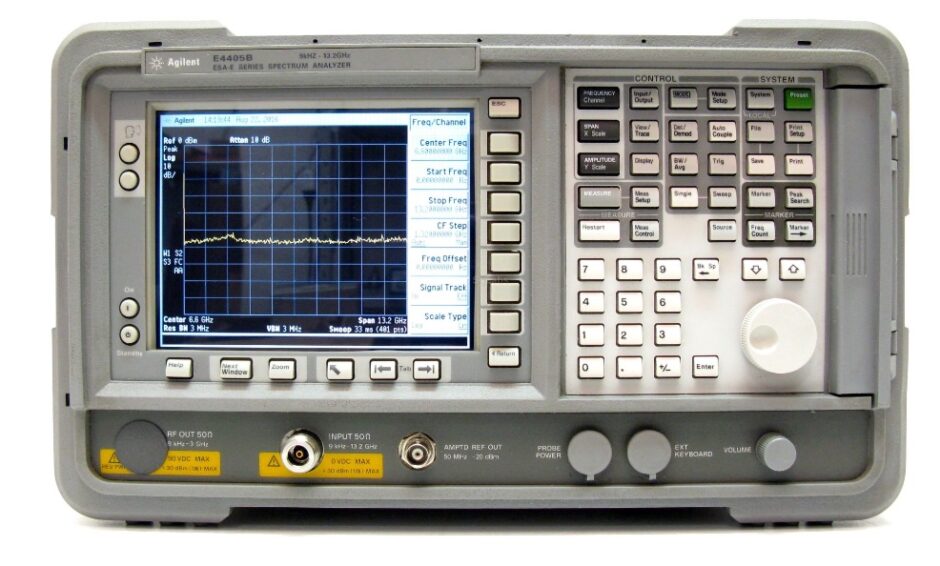
Keysight Technologies had spent decades building best-in-class hardware for engineers, researchers, and scientists across RF, signal analysis, and electronic design. But that history came with a cost: each product line had its own software, its own interface conventions, and its own model of the user. Engineers moving between Keysight instruments were navigating a fragmented landscape of applications that did not know about each other.
The strategic imperative was clear. Hardware innovation cycles were slowing; software could move faster, add more value, and create durable customer relationships. PathWave was Keysight's answer: a unified platform that would let users design, simulate, test, and manage products across the full development lifecycle without context-switching between disconnected tools.
The design challenge was not a single interface. It was coherence at scale: establishing shared UX patterns across an ecosystem of applications built by separate teams across multiple continents, each with its own history and its own interpretation of what the product should be.
My Role and Constraints
I was embedded in the PathWave product team as a senior UX designer throughout the platform's development, from foundational research through the 1.0 general availability release. Key areas of ownership included:
- Animation and Interaction Standard: I authored and published this component of the UI Design Standard, which governed motion and interaction behavior across all PathWave applications.
- Axure Component Library: I built a reusable, standards-compliant component library in Axure that reduced prototype production time and served as a shared reference for product and development teams throughout the SDLC.
- User Testing Lead: I led the final pre-release user testing for PathWave 1.0, coordinating test scripts, participant management, and results analysis for a formal third-party lab study.
- Georgia Tech Research Partnership: I developed and established a grant program with Georgia Tech's Institute for People and Technology to create an ongoing academic partnership for user research and innovation tied to PathWave's future development.
The primary constraints shaping the work were significant: legacy application codebases with varying UI frameworks, a global team structure with design decisions made across multiple time zones, an enormous range of user hardware contexts (from small field instruments to 60-inch 4K laboratory displays), and a user population whose daily work could not be disrupted by a disorienting change in interface conventions.
Discovery: Finding the Wider Need
User research for PathWave predated the platform itself. A series of individual application redesigns in the years prior served as both tactical improvements and explicit research exercises, testing UI directions and surfacing user behaviors that would inform what became the PathWave initiative.
Once the platform effort was formally underway, the team conducted extensive contextual research with Keysight customers across a range of roles and use cases. What began as improvement interviews for individual applications revealed a consistent and more fundamental issue: users' workflows were fragmented not because any single tool was broken, but because the tools did not connect.
- Interviews conducted with dozens of users representing distinct roles across the product design, testing, and development lifecycle
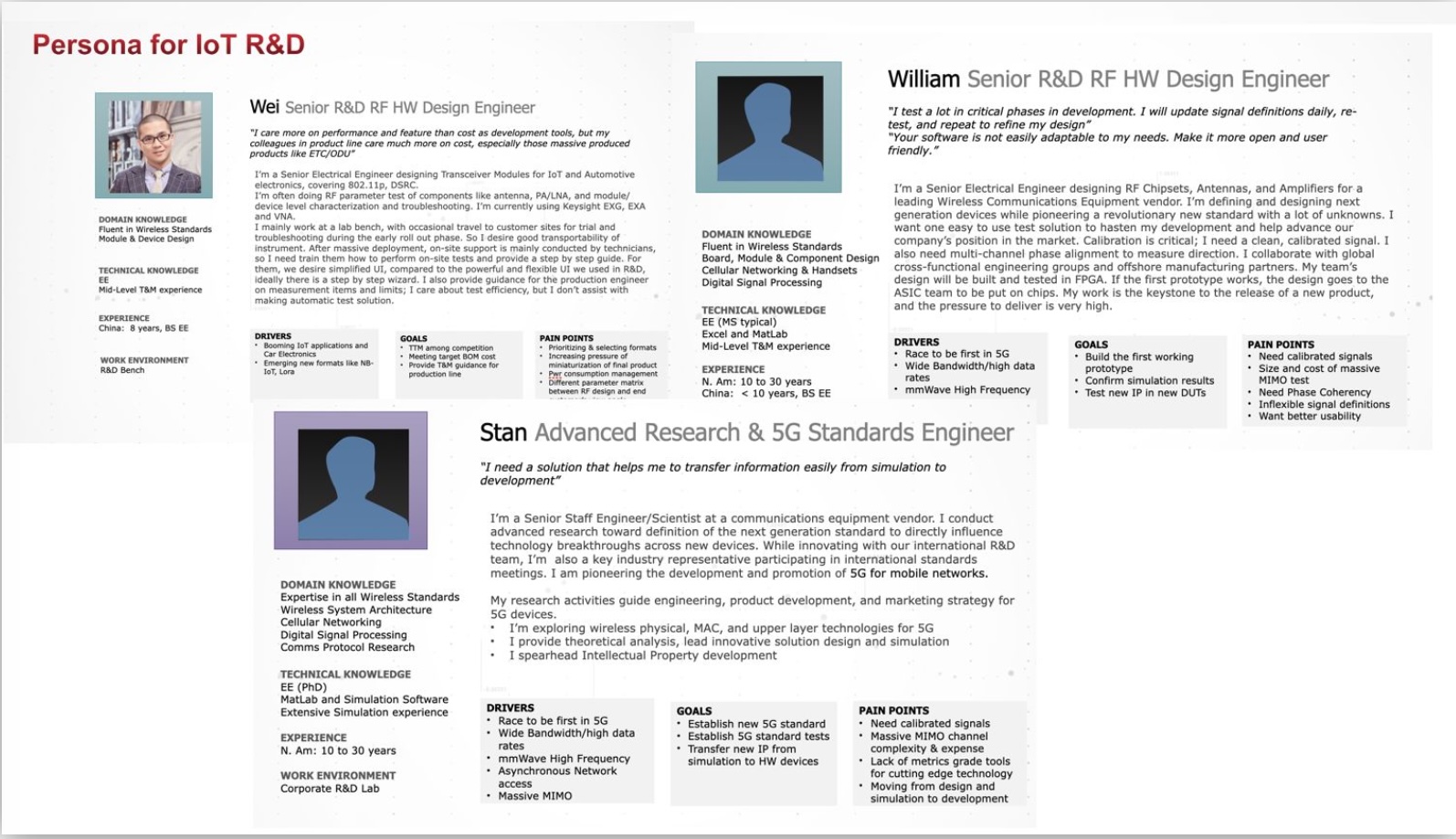
- 20 personas developed, segmented by role and function within the PathWave workflow — from Design Engineers to PathWave Administrators and Asset Managers
- Pre-existing personas from individual application research were used as starting points, then substantially revised based on platform-context research
- Personas functioned as active design references throughout development, not static deliverables — used in collaboration with the Product Team to align development requirements with actual user roles
Building a Shared Foundation: The UI Design Standard
A universal application style guide was both the most important and least glamorous deliverable of the PathWave process. It was the precondition for everything else.
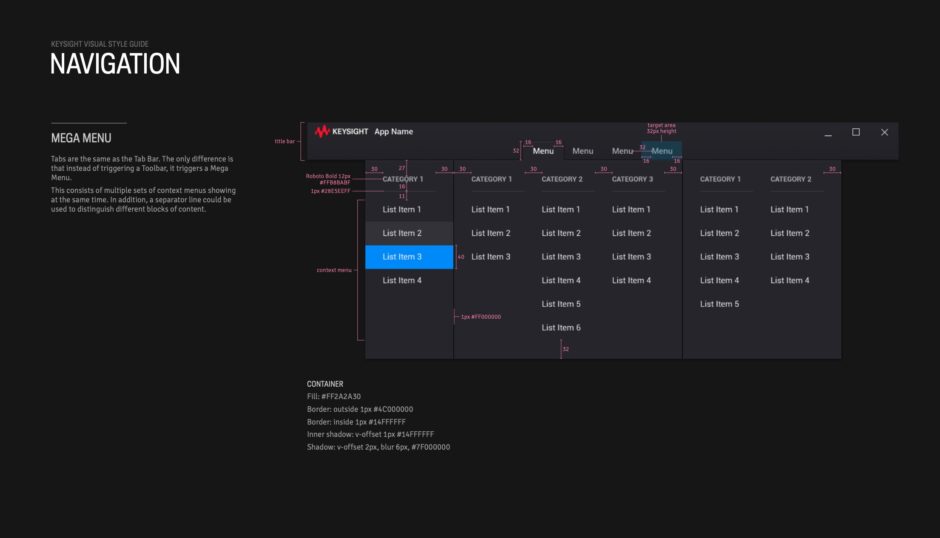
The standard emerged from the individual application redesign work and was developed by the UI Council, a company-wide global team whose composition reflected the scale of PathWave's reach across Keysight's product portfolio. The guiding design constraints were demanding:
- Screen size range spanning roughly 2″×3″ handheld displays to 60″ 4K monitors in laboratory environments
- User environments ranging from controlled desktop labs to mobile field testing vehicles and cellular tower installations
- Visual clarity and a coherent progression from existing application conventions, to reduce retraining friction
I authored and published the Animation and Interaction Design Standard as part of this broader style guide effort. Changes to the standard were tested in parallel with application design iterations, giving the team empirical feedback on how the standard performed with real users before it was locked.
The standard consistently received high usability ratings from users across all stages of testing. It also served as the direct input for the Axure component library I built, which made subsequent prototype production substantially faster and ensured standards compliance across the team's output.
Key Design Decisions
| Decision | Alternatives Considered | Rationale | Reflection |
|---|---|---|---|
| Embed UX as a continuous process, not a phase | Waterfall handoff model, or UX review at milestone gates only | The scale and complexity of PathWave made late-stage design corrections prohibitively expensive. Embedding designers within product teams for iterative design-test-redesign cycles was the only model that could keep pace with development. | The model worked, but required sustained advocacy. Teams with no prior embedded design experience needed time to understand what they were getting and how to use it effectively. |
| Build a shared component library before building application prototypes at scale | Each team prototype independently, consolidate patterns later | Bottom-up pattern consolidation across a platform of this size would have produced inconsistency faster than it could be resolved. A top-down shared library, even an imperfect one, gave teams a common language earlier. | Earlier alignment across dev teams on the technical implementation of components would have reduced friction at the handoff stage. |
| Establish a formal academic partnership for ongoing research | Internal research only, or ad-hoc external research on a project basis | The Georgia Tech IPAT partnership gave Keysight access to rigorous research methodology and academic expertise that a product team alone could not sustain. It also created a forward-looking research capability tied to PathWave's future roadmap. | The lead time required to establish the grant program was longer than anticipated. Starting that process earlier would have allowed the partnership to contribute to PathWave 1.0 more directly. |
User Testing: Three Levels of Rigor
PathWave's complexity required a structured approach to user testing that could operate continuously without overwhelming development velocity. The team used a three-tier model:
- Baseline testing: Conducted with users against the current state of an application or platform design. Used to anticipate design direction for upcoming sprints and to set parameters for requirements.
- Ad-hoc sprint testing: Conducted with representative end-users within Keysight and corporate partners every 2–3 sprints for small-scale design changes. Maintained a continuous feedback loop without the overhead of formal test coordination.
- Pre-release formal testing: Conducted for significant milestones using third-party user testing agencies, in-person and remote lab facilities, and blind recruitment (participants unaware of Keysight's involvement). I served as user testing lead for the PathWave 1.0 pre-release study.
Axure prototypes were the primary testing vehicle, allowing task-flow walkthroughs and targeted scenario-based studies. Test scripts, test management, and results analysis were coordinated by the UX team and fed directly into sprint planning.
Outcomes
PathWave launched as Keysight Technologies' flagship software platform and the centerpiece of the company's strategic pivot from hardware manufacturer to software-centric business. The public release framing from Keysight's CTO positioned PathWave as the company's commitment to software solutions that help customers streamline their workflows across the full product development lifecycle.
At the design and process level, the engagement produced:
- A published UI Design Standard and Animation/Interaction Guide adopted across the PathWave product suite
- A reusable Axure component library that accelerated prototype production and ensured standards compliance across multiple product teams
- 20 validated personas used as active design references across the full development lifecycle
- A three-tier user testing program that maintained continuous user feedback without disrupting development velocity
- A formal academic research partnership with Georgia Tech's Institute for People and Technology, establishing an ongoing innovation channel for PathWave's future development
What I Would Do Differently
The Georgia Tech partnership was one of the most strategically significant contributions I made to the PathWave program, and I started it too late. The grant program establishment process took longer than anticipated, which limited how much the academic research output could directly inform PathWave 1.0. On a program of this duration, that kind of infrastructure investment should be initiated at the discovery phase, not during active development.
I would also have pushed harder for earlier cross-team alignment on the technical implementation of shared components. The design library was well-adopted, but the handoff between design standards and development implementation created friction that better-defined front-end specifications could have reduced.