Product Context
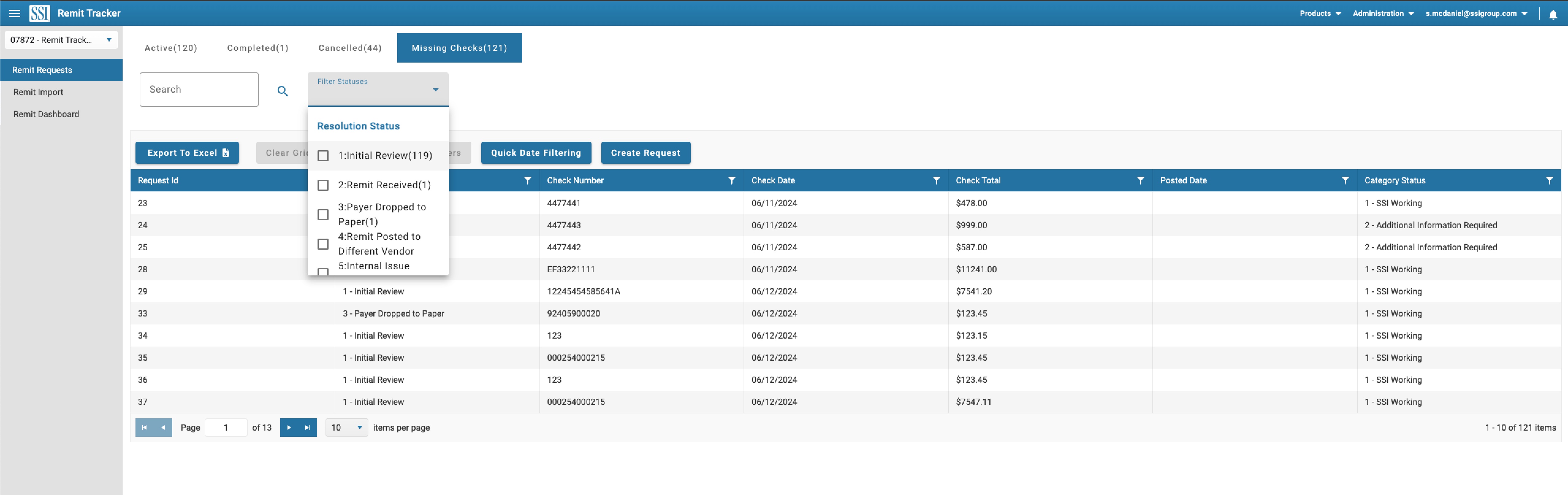
The SSI Group is a healthcare data intelligence and automation company whose platform spans the full revenue cycle — from pre-service eligibility verification through claims submission, clearinghouse processing, denial management, remittance reconciliation, and analytics. The platform serves both providers and payers, operating across more than fifty states and territories.
The breadth of that product surface is the defining context for design work at SSI. Eight interconnected product areas — Claims Management, Clearinghouse, Denial Management, Eligibility, Remittance Management, Insights and Analytics, Payer Claims Operations, and Prior Authorization — share a user base of billing specialists, claims coordinators, denial management teams, and financial operations leadership. These users move between product areas as part of their daily workflow; inconsistency across those boundaries is not a cosmetic problem, it is an operational one.
RCM software operates in a realm of regulatory complexity, high transaction volume, and direct financial consequence. A missed denial appeal window has a dollar value. An eligibility check that returns ambiguous data creates downstream rework. The design imperative is precision and clarity under pressure — interfaces that help people make the right call quickly, not interfaces optimized for first impressions.
The Design Challenge
The core challenge at SSI was one of coherence at scale. A platform that had grown product-by-product across the RCM lifecycle accumulates divergence: different treatments for the same data types, inconsistent navigation patterns between modules, component-level decisions made independently across teams that compound into a meaningfully different experience depending on which part of the product a user is in.
For users who work across the full revenue cycle — and many do — that divergence is friction they absorb every day. For a platform positioning itself around automation, data intelligence, and operational efficiency, the user experience is not separable from the value proposition.
Design Patterns
Establishing company-wide design patterns meant working across product teams to identify where the platform's UX was diverging and where a shared approach was both feasible and worth the alignment cost. Not every inconsistency warrants a pattern — the work requires judgment about which decisions are high-traffic enough to justify standardization and which are legitimately product-specific.
The RCM domain has its own interaction vocabulary: claim status workflows, denial reason codes, remittance posting flows, eligibility response handling. Patterns built for this context need to reflect how the domain actually works, not generic enterprise UI conventions imposed on top of it. Getting that right requires the kind of operational familiarity that comes from spending time with the workflows, not just the interfaces.
Research Methodology
SSI's users are specialists. A billing coordinator working denial management has a different workflow, different priorities, and a different tolerance for interface complexity than a financial operations director reading analytics dashboards. Research methodology at SSI needed to account for that range — producing findings specific enough to be actionable for individual product teams while contributing to a shared understanding of the user base across the platform.
The methodology framework established processes for recruiting from SSI's existing client base, structuring interviews and usability studies around RCM-specific task scenarios, and synthesizing findings in a form that connected back to product and development priorities. Healthcare RCM has an unusually high proportion of expert users — people who have been doing this work for years and have strong, well-formed opinions about software. Research with this population is more adversarial interview than gentle probe; getting honest signal requires knowing enough about the domain to recognize when a stated preference is masking a workaround.
Meridian RCM
Domain expertise is difficult to demonstrate in a portfolio when the underlying product is proprietary. Meridian RCM is a functional claims-processing dashboard built to show what RCM software grounded in real operational knowledge looks like — as distinct from what an AI tool produces when given a generic "build a healthcare dashboard" prompt.
Meridian models a full claim lifecycle — submission through payment, with particular attention to denial management — drawing directly on the workflow patterns and operational realities of the SSI domain. The quality of the result reflects the specificity of the direction given to it: the six claim stages, the denial kanban model, and the claim detail drawer were all designed from an understanding of where RCM workflows actually break down, not from a generic dashboard template.
View the Meridian RCM Case Study →